
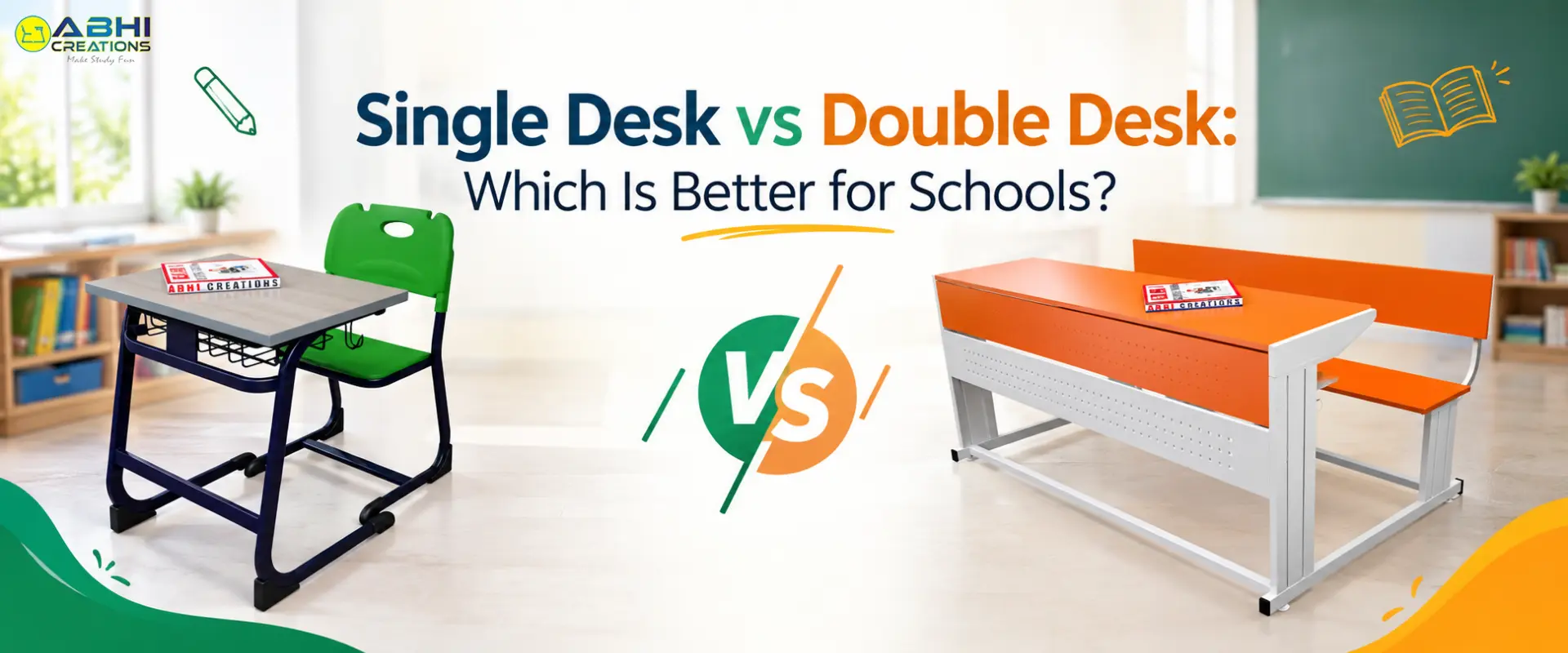
A typical 40-square-meter classroom in India must legally seat 30 students. That spatial math dictates almost every furniture choice. When administrators face the single desk vs double desk decision, they balance individual focus against peer interaction, floor space against budget, and structural longevity against classroom flexibility.
At Abhi Creations, we have spent 25 years manufacturing institutional furniture, and we see schools make this choice every procurement cycle. This guide breaks down the exact differences to help you choose the best school desks for classroom seating.
What is the core difference between single and double school desks?
The primary difference between single and double school desks is workspace allocation and footprint. A single seater school desk provides one student with a dedicated, isolated work surface, while a two seater school desk shares a continuous tabletop between two students, reducing the required floor area by combining support structures into one unit.
Structural design and footprint
Structurally, a single desk stands alone. It features four legs and a top designed for one student. A double desk, however, spans a wider top—often 1200 mm to 1500 mm across—supported by a shared frame. By sharing the central underframe, the double desk saves roughly 20 percent of the floor space required by two separate single units. This structural consolidation makes a noticeable difference in tight rows.
Shared vs individual student workspaces
The workspace dynamic shifts entirely between these two models. A single desk creates a strict boundary. Students keep their books, supplies, and arms to themselves. A double desk demands cooperation. The shared surface means students must negotiate spatial boundaries constantly. If you want strict individual zones for testing, single desks win. If you want students to easily share a textbook or pair up for an assignment, double desks are the better option.
What are the main advantages of a single desk for classroom seating?
Single desks offer maximum spatial independence and layout flexibility. Because they do not connect to another student's workspace, teachers can arrange them in traditional rows, U-shapes, or scattered clusters for testing days without negotiating shared desk legs. This autonomy makes them ideal for environments where individual focus is the priority.
Improving student focus and reducing distractions
When students have their own designated space, off-task behaviors drop. There are no desk-mate disputes over elbow room or shared desk space. A 2024 industry survey on classroom layouts found that isolated seating arrangements reduce disruptive peer interactions by 18 percent during independent study periods. For subjects requiring deep concentration, a single seater school desk provides a clear boundary. Students own their space.
Flexible single seater vs two seater school desks arrangement
Modularity is the single desk's strongest trait. You can rearrange a room of single desks in minutes. Try moving a row of heavy double desks, and you will quickly appreciate the lighter footprint of individual units. Teachers can pull desks apart for quizzes or push them together for group projects. When comparing the single seater vs two seater school desks, the single seater offers unmatched adaptability for dynamic teaching methods. You can explore various adaptable seating options through our trusted school furniture manufacturer catalog.
When should schools choose a double desk over a single desk?
Schools should choose a double desk when classroom space is tight and collaborative learning is a daily priority. Double desks allow two students to share a single frame, instantly maximizing room capacity and encouraging peer-to-peer interaction without requiring additional floor space or separate group tables.
Maximizing classroom space and seating capacity
In overcrowded classrooms, every square centimeter matters. A double desk seats two students using the footprint of roughly one and a half. If you need to seat 40 students in a room built for 30, double desks are often the only viable option. According to the Government e-Marketplace procurement guidelines, spatial efficiency is a primary metric for institutional furniture approval. Double desks help schools meet high-density seating requirements without violating safety aisles.
Fostering peer collaboration and teamwork
Modern pedagogy leans heavily on collaborative learning. Double desks naturally facilitate this. Two students share a workspace, making pair-work seamless. A student can easily slide a worksheet to their partner. As educational design expert Dr. Lynda M. noted in a 2025 furniture design trends report, "Shared seating surfaces naturally lower the barrier to student interaction, making teamwork the default state rather than a forced activity." For group-centric curriculums, the double desk is a tool for active learning.
How do single and double desks impact different age groups?
Age dictates desk choice because physical size and classroom behavior change as students grow. Younger children benefit from the shared, playful nature of double desks, while older students often need the defined boundaries and individual focus that single desks provide. Ergonomic requirements shift drastically from junior to senior grades.
Junior vs senior classroom furniture requirements
For junior classrooms, double desks work exceptionally well. Young children rarely need vast personal space, and the shared surface encourages social development. They learn to share and interact safely. You can see this in our junior classroom furniture lines, which feature colorful, rounded double desks designed specifically for early education. Senior students need a different setup. High schoolers require more space for thick textbooks, laptops, and exams. A single desk gives them the physical real estate they need.
Ergonomic seating considerations
Ergonomics cannot be an afterthought. A desk must fit the student. Junior desks sit lower, around 520 mm in height, accommodating smaller frames. Senior desks rise to 760 mm to support teenagers. When comparing the single desk vs double desk for older students, single desks often offer better ergonomic alignment. Double desks force two students to share one height. If a tall student and a short student share a double desk, one will suffer poor posture. Single desks eliminate this mismatch.
Which desk type is more durable and cost-effective for schools?
Double desks generally offer better cost-effectiveness per seat because they use less steel and require fewer welds than two separate single desks. However, single desks often outlast double desks in high-impact environments because they experience less structural torsion and lack the shared stress points inherent in wider frames.
Material quality and long-lasting classroom furniture
Durability depends entirely on material quality. We manufacture both desk types using high-gauge steel tubes and pre-laminated particleboard. A well-built single desk will survive decades. A poorly built double desk will warp within a year. The advantage of double desks here is structural efficiency. One shared frame means fewer legs to break. The advantage of single desks is isolation. If one desk breaks, you replace one desk. If a double desk fails, two students are left without a seat. For long-lasting classroom furniture, investing in high-quality materials matters more than the desk configuration.
Maintenance and long-term return on investment
Maintenance is where the single desk vs double desk debate tilts. Single desks are lighter. They are easier to move for cleaning. Double desks are heavier and harder to lift, which means janitorial staff often clean around them, leading to dust buildup in corners. However, double desks have fewer total legs per student, meaning fewer rubber floor caps to replace. If you want the highest return on investment, consider your maintenance staff's capabilities. Heavy double desks require heavy-duty maintenance.
How do you choose the best school desks for your layout?
To choose the best school desks, measure your classroom dimensions, map out your teaching style, and calculate your budget per seat. If your room is small and your teaching is collaborative, buy double desks. If your room is spacious and your teaching is test-heavy, buy single desks.
Evaluating room size and infrastructure
Start with a tape measure. Map out the walking aisles. Indian school safety guidelines require a minimum 1200 mm clear aisle between desk rows. If your room is narrow, double desks maximize seating while keeping aisles clear. If your room is wide, single desks provide a more open, less crowded feel. Do not forget doors and windows. Desks should never block natural light paths or emergency exits.
Aligning furniture with modern teaching methods
Your furniture must match your pedagogy. Lecture-based teaching works perfectly with traditional single desk rows. Project-based learning thrives with double desks. Many modern schools now mix both. They use single desks for individual study halls and double desks for collaborative labs. This hybrid approach gives teachers the tools they need for every lesson plan.
What are the final considerations for single desk vs double desk for schools?
The final decision in the single desk vs double desk for schools debate comes down to your institution's specific daily needs. Single desks win on individual focus, ergonomic matching, and layout flexibility. Double desks win on spatial efficiency, collaborative learning, and per-seat cost savings.
When procurement heads ask us for a definitive answer, we tell them to look at their teachers. If your teachers lecture and test constantly, choose single desks. If your teachers run group projects and peer tutoring, choose double desks. The advantages of single desk and double desk are entirely contextual to your classroom floor plan and teaching methodology.
Key Takeaways
Single desks provide individual focus, better ergonomic matching, and unmatched layout flexibility for dynamic teaching methods.
Double desks save roughly 20% of floor space and naturally foster peer collaboration in crowded classrooms.
Junior students benefit from the shared, playful nature of double desks, while seniors need single desks for larger materials.
Choosing the best school desks depends entirely on your room dimensions, budget, and daily teaching pedagogy.
Comparison
| Feature | Single Desk | Double Desk |
|---|---|---|
| Workspace | Individual, isolated surface | Shared, continuous tabletop |
| Floor Space Efficiency | Requires more area per student | Saves roughly 20% of floor space |
| Student Collaboration | Limited to grouped arrangements | Naturally fosters peer teamwork |
| Ergonomic Flexibility | Matches individual student height | Forces two students to share one height |
| Ideal Age Group | Senior students needing focus | Junior students sharing tasks |
| Maintenance | Lighter and easier to move | Heavier but has fewer total legs |
Frequently Asked Questions
What is a two-person desk called in schools?
A two-person desk is commonly called a double desk or a two seater school desk. It features a wider shared tabletop supported by a single frame, designed to seat two students side by side. This configuration maximizes floor space and naturally encourages peer collaboration in the classroom.
What are the key differences between a single desk and a double desk?
The main difference between single and double school desks is workspace structure. Single desks provide isolated, individual workspaces with dedicated frames, while double desks offer a shared surface that promotes collaboration. Double desks save significant floor space, whereas single desks provide better ergonomic alignment and layout flexibility for students.
Is a double desk better for saving space in a classroom?
Yes, a double desk is highly effective for saving space. By combining two seats into one shared frame, it reduces the total floor area required compared to two separate single desks. This structural consolidation saves roughly twenty percent of the floor space, making it ideal for maximizing seating capacity in tight classrooms.
Which type of desk is best for junior classroom furniture?
Double desks are often best for junior classroom furniture. They encourage social interaction and sharing among young children, accommodating the smaller physical footprints of early education environments. The shared seating surface naturally lowers barriers to student interaction, making teamwork a default state rather than a forced activity.
How do I choose the best school desks for classroom seating?
To choose the best school desks for classroom seating, evaluate your room size, teaching style, and student age group. Prioritize single desks for individual focus and test-heavy environments, and choose double desks for collaborative learning and maximum space utilization in crowded, high-density classrooms.
← Back to Blogs